Thursday, 31 May 2012

Guest Lecture- John Myers

Today, on Wednesday 29th February we had a Guest Lecture, John Myers who is an Artist after doing a degree in Art where he specialised in Sculpture and has had a successful career out of building sculptures and having them exhibited in numerous Galleries. As well as Sculpture work he has done a bit of Photography which too, has been successful and has had his main work exhibited at Galleries across the Midlands.


One of Myers projects that he spoke about during the lecture was named 'Middle England' which has shown to be his most successful piece of work, which consisted of a number of portraits of individuals as well as famillies living in Stourbridge and the black country, but most of his images are of people he knows. The main people that John Myers looked up to and inspired him were Diane Arbus, August Sander, E.J Belocq and Lewis Hine.

His work is mainly shot with a 5x4 format camera, where he uses natural light instead of artificial lighting. He also likes to shoot his photographs in a documentary sort of style, so he captures the people in their natural setting without having to set up props or any other extra objects.


http://www.ikon-gallery.co.uk/programme/current/event/495/middle_england/


 As well as portraiture he also did a series of photos which were of televisions and substations, which I didn't really understand why he wanted to photograph these objects. I much prefer his portraits as they have more meaning, and can tell more of a story with the expression of the people or by how they are acting in the picture, due to him taking natural photographs.

Wednesday, 9 May 2012

Extreme - Fujifilm Student Award

For this assignment, which is going to be completed over four weeks, in which we are going to be entering the 'Fugifilm Student Awards'. The assignment title is called 'Extreme' With this I will be able to choose any subject to which I feel is portrayed as being extreme, whether this being Weather, sports, or body piercings. We are to take our final images on film camera, being either colour or black and white film. We are not able to edit our images as digital cameras are not allowed to be used.

There are many definitions of the term extreme, but is mostly commonly know for it meaning dangerous or exceeding the degree of the matter, and going beyond the average or ordinary. When the term is used within Extreme sports it can be defined as being dangerous or hazardous.

As there is a large field in which extreme can be connected with, so using the internet I was able to look at different types of 'Extreme' During this time I came across many subjects that I could use, these included:

*  Hairstyles
*  Tattoos
*  Face/Body paintings
*  Sport
*  Make overs
*  Fashion
*  Close ups

For my Extreme theme, I decide to choose to do Extreme close ups of household objects, I decided to do this as there are a lot of things I am able to do with them, and will not be limited to what I can take photographs of, these could include flowers in the house, vases, ornaments or even different sections of walls/ wallpapers.


These are a few images from my first photo shoot of close ups, I randomly chose objects in my house that I thought may work well and give me different ideas to develop them further or relate new images to them. The top image is of roses, I like the idea of photographing natural things in different environments, and the colors I thought were quite vibrant so by therefore doing a close up shot you can see the different tones of pink. The image in  the middle is just a simple house decoration hanging from a drawer handle, Although it is not all completely in focus, I think it works well by having the top of the heart in focus it allows you to see the contrasting colored pattern on the decoration. The next image is one of my favourites.

Wednesday, 25 April 2012

Martin Parr

Martin Parr is a British documentary photographer and photojournalist, he is a member of Magnum Photos and focuses on the aspects of modern day life of people, and is also a member of Magnum Photos. He started working as a professional photographer and has taught photography from the mid 1970s, he was recognised for his black and white photography, but then he switched to colour photography in the 1980s.
Since 1994 Martin Parr has been a member of Magnum Photos, and has had almost 50 books published and has ha his work featured in over 80 exhibitions worldwide. The images that he produces are very bold and burst in colour and he likes to add humour to his work. The way he creates these bold colours is by using a ring flash, Macro Lenses and high saturation film. As well as taking photographs he is a collector of postcards and other objects to show popular culture, since the 1970s Parr has been publishing postcards and have become very popular with the public.


For this task I was to take a minimum of 3 photos that were inspired my Martin Parr, which enabled me to look at themes such as colour, humour and people. I decided to look at colour as I thought I could capture some bright close ups.


                      This is my favourite image I took, as I think it looks natural and that the cups and teapot have just been left n the table, and it doesn't look as if it has been purposely set up for the photo. I also like the contrast of the colours, especially how the yellow teapot and the flowers stand out from the rest of the objects which have a more pastel colour.


This is another image that I took, inspired by Martin Parr. I wanted to try a different approach to my previous image. In some of Martin Parrs work he takes pictures of people on the streets, in a normal day to day setting where none of his work is set up, it is all natural. In this picture I wanted to try and get it in the style of one of his pictures with the people in their normal setting. Also by having the bright colours on the two signs, which I altered the contrast to make them stand out more. I think that by doing this shows more of a similarity between this picture and Martin Parrs work.

Monday, 23 April 2012

Guest Lecture- Jade Birchnall

Today, On Wednesday 1st February we had a Guest Lecture by Jade Birchnall who is currently a photography student at Manchester Metropolitan University. During her talk she explained her work and some of the projects she has done during her time at University.

Some of her work that she showed us today was very interesting, she showed us a project she recently did which was focusing on the effects of senile dementia, her grandmother suffered from this illness so it was particularly interesting as she could relate to the topic herself, which gave it a more personal feel. In one part of the presentation she used the voice of her grandmother over one of her images that she exhibtited. These images included a note of instructions for her grandmother to read, such as visitors she will be having in the day and this note included what they had to do. As well as photographing this she also contacted the Nursing home named 'The Little Sister Of Poor' which is a Roman Catholic religious institute for women who suffere with Dementia and this particular Nursing Home was run by nuns. During her time in  the Nursing home she did portraits of the people who lived there. During the lecture she said that she felt awkward whilst in the home and she had to build a form of trust with the residents before they would allow her to take the photos.

Her main choice of camera is a medium format but she also took a lot of photos using a film camera but this made the images grainy, which she wasn't keen on, so then tried using a lighting kit to enable the images to become less grainy.


The next set of work that Jade showed us was completely different from the previous work she had done. She visited The Baby Platinum Gentlemans Club to photograph the peole who worked there, who were mainly strippers. She went here with her friend named Amy Clarkson so they could both take different photographs where Amy took full body shots of the strippers and Jade took photographs of different parts of the body. I think that the images that jade took were much less provocative than the full body shots which came across as quite intimidating and were quite elegant.

I enjoyed the talk from Jade, especially as she is of a similar age which I think made it more interesting as nit gave me an insight to what could be in the future for myself. Not only did she talk about her own work but she was able to give information on what University life will be like and how it differs from College, which was really helpful.

Jill Cole - Guest Lecture

Today, Wednesday 18th January we had a Guest Lecture, Jill Cole who is a Documentary Photographer and artist. In her work she uses the environmental issues that occur on a day to day basis and portrays that within her work. Not only is she an Artist and Photographer but she participates and conducts her own lectures in order to show others how her wok is influenced. During her lecture she talked about her current project she is doing, in which she uses a layering technique where she takes a number of photos and layers them on top of one another and bring pieces of each image through to the top layer giving off really interesting effects. I like the way she wants to show the different layers of the forest by using this technique.

One piece of her work that I really like is called 'Between here and there' which created in 2009 consists of her putting birds into individual bags and photographing the movement. At first I didn't like the idea of the birds being confined into a bag and then photographing the struggle of them trying to get free, But at the end of her work she writes what exactly happened and what the images were trying to show. The birds were part of the National Nature Conservation and were waiting to have their identification tags attached to their legs, so while they were waiting she was able to photograph them, as soon as this had happened they were then released into the wild again, and none of the birds were harmed. The idea of this project was to show the movement and how fragile the birds are.


Monday, 27 February 2012

Hayward Gallery - London Visit

On the 17th November we went on a trip to London to visit 3 different Galleries Somerset House, The National Portrait Gallery and the Hayward Gallery. Each Gallery was completely different, with both the type of work and the was that it was exhibited. The Hayward Gallery contained two types of work, one half of the Gallery was by the artist George Condo, his work was in an animated style and was quite strange. The other piece of work in the Gallery was by Pipilotti Rist, this was very interesting in the ways that this work had been produced and shown. The National Portrait Gallery hels the Taylor Wessing Portrait Prize which consisted of different types of portraits by a number of artists, there was a range of varitey with each portrait and they were very interesting. And finally Somerset House exhibited '20 years of the dazed and confused' Magazine, this was really interesting and had a wide range of interesting Fashion Photography.

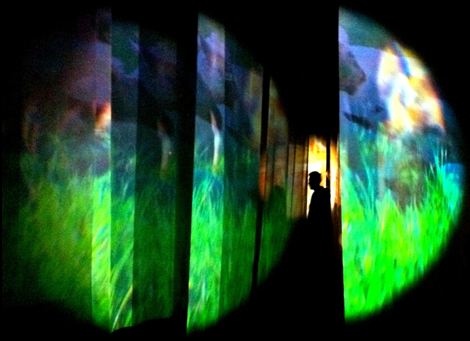
My favourite exhibition that we visited was the Pipilotti Rist in the Hayward Gallery, the exhibition consisted of sculptures, videos and other pieces of Artwork that showed her career from when it began in the 1980's to the present day. The exhibition is named ' Eyeball Massage'. The exhibition itself is very energetic, although has a calming and relaxed feeling to it, in the way it has soothing music and flowing movement within the videos exhibited.


Throughout the exhibition there were so many different videos and each one was shown in its own special way, especially ones that weren't shown too obviously on a big screen, some were placed in small holes in the floor so you really had to look into it, others were projected onto material that was suspended from the ceiling. My favourite part of the exhibition is the way in which she allows the audience to be incorporated within her work, as it allows a personal connection between the viewer and the work, the audience do not then feel rushed, they can walk around at their own pace. I feel that the atmosphere in the exhibition was very relaxed and calming, it took you into a world of peace and quietness. I think this was due to the soothing noises and ambient lighting, together with the soft flowing movement of the videos, none of the videos were showing aggressive or harsh movements. Combining this peaceful sound such as trees blowing in the light breeze made the exhibition more interesting as it made you feel you were personally in the videos.


I really enjoyed this exhibition, I found the ways the videos were shown very interesting and unique. Even though they are not really photography related and more video, I still like the attitude that it portrays, I think it works better with video than it would have perhaps with photography, due to the fact that you are able to see the flowing movements. This is an exhibition I would definately visit again in the future and I think it is a technique definately keep in mind for the future.

The Invention Of Photography

A photograph is created by light falling onto a light sensitive surface usually by using film or digitally, most are to be created by using a camera and by using the lens to focus the visible wavelength of light that is also visible to the human eye.  The term 'Photograph' was coined by Sir John Herschel in 1839 and is based on the Greek term 'Phos' meaning light and 'Graphe' meaning drawing.

The first black and white photograph was made in 1822 by French inventor  Joseph Nicephore Niepce built on a discovery by Johann Heinrich Schultz that silver mixture darkens under exposure to light.


The process of this technique was refined by Louis Daguerre, he found that by firstly exposing the silver to the Iodine vapour, before exposure then to the mercury vapour which was heated to 75 Celsius and exposed them to light for several minutes, after the photograph was taken the image was then 'Fixed' in salt water. This is what then led to the famous Daguerreotype. Most of his work consisted of portraits as they were thought to be more rare and sought after, this process took several minutes and differed from his pictures of the streets in Paris which showed no human activity or and people in the street, this was not because he didn't photograph any people, due to there being a long exposure with movement the people became invisible, this was when the faster lens' were introduced for portraiture. 


In the 1840s the first attempts of colour photography was tested. Early results were encouraged by obtaining a solar spectrum by projecting it onto a surface, this proved to be successful, but the dim  image found in the camera required an exposure for hours even days. Over the next 70 years or so, experiments increased and raised hopes making nothing of practical value. The 'Three Colour Method' was first suggested in 1855  by Scottish Physicist James Clerk Maxwell.


In the late 1981, Sony invented the first electronic camera called the 'Sony Mavica' This was a new camera that didn't have a film to work and was the first commercial electronic camera. After images were taken on the camera they were then put onto a television monitor or colour printer to be viewed. Event though this was technically the first electronic camera to be made, it is not considered to be a true digital camera, it was just the start. Since the 1970's Kodak had invented a number of sensors that converted light into pictures, until Kodak then came up with the worlds first mega pixel sensor that produced 1.4 million pixels and was capable of recording a 5 x 7 inch quality print. 


This is the Sony Mavica, which was the first electric commercial cameras.